
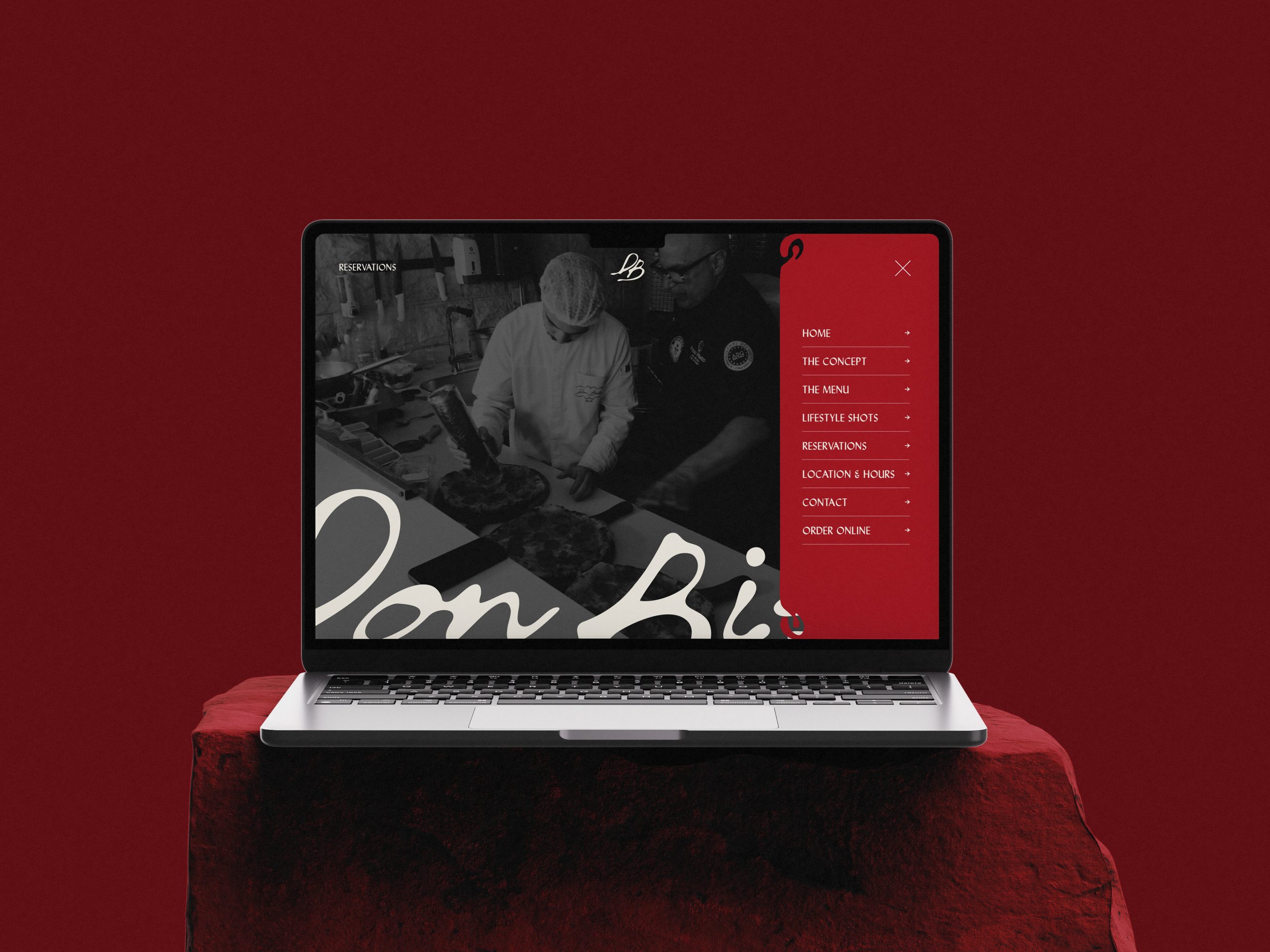
Don Bisho
An experimental GSAP and ScrollTrigger experience using pinned scenes, parallax, and layered dish transitions across Don Bisho's three locations.
Case Study
An experimental GSAP and ScrollTrigger experience using pinned scenes, parallax, and layered dish transitions across Don Bisho's three locations.
Don Bisho was created as an experiment in how far a restaurant website can move beyond conventional page design while remaining useful. The brand is rooted in the traditions of Italian trattorias, flame, hand-stretched dough, slow-prepared sauces, generous plates, and warm hospitality. Its locations at Garden 8 in Cairo, El Gouna, and Silversands on the North Coast give that identity several physical settings. The digital platform needed to connect them through one unmistakable personality.
Monarq approached the website as an advanced front-end experience built around continuous scrolling. Instead of arranging content into static sections separated by ordinary transitions, the platform uses GSAP and ScrollTrigger to choreograph scenes, images, typography, dishes, and brand moments as the user moves. The result feels cinematic and experimental, but its menu, reservation, and online-order routes remain part of the practical restaurant journey.
Client Context
Don Bisho combines Italian culinary tradition with a bold contemporary identity. The story begins with the familiarity of trattorias and the physical craft of the kitchen: dough stretched by hand, sauces given time, heat, flame, and food made for sharing. That warmth is expressed across locations serving different urban and coastal audiences.
Garden 8 places the brand within Cairo’s social and dining landscape. El Gouna connects it to an established destination community, while Silversands brings it into the seasonal energy of the North Coast. The website had to feel coherent across all three without becoming a generic multi-location restaurant directory.
The Strategic Challenge
Highly animated websites often become visual demonstrations detached from the business they represent. Restaurant websites face the opposite risk: they can become so focused on menus and contact information that they lose every trace of personality. Don Bisho required both extremes to be resolved.
The challenge was to create an experimental experience impressive enough to represent Monarq’s technical portfolio while still communicating food, character, locations, and clear next actions. Movement had to make the brand more understandable, not merely prove that animation was possible.
Monarq’s End-to-End Role
Monarq led the project across digital strategy, UX, interface and motion design, content structure, creative development, and final implementation. The work required animation thinking from the beginning because the layout, pacing, and technical architecture depend on how elements enter, remain, transform, and leave the viewport.
Development was therefore not a final translation of static screens. GSAP timelines, responsive states, media framing, content order, and interaction behavior were designed together. This allowed the final site to preserve the intended rhythm instead of treating motion as decoration added after approval.
An Experimental Development Direction
Don Bisho was used as an opportunity to explore an ultra-modern development style within a commercial hospitality project. The platform tests how scroll can become the primary control for a narrative, how layered media can transform without losing continuity, and how complex choreography can remain responsive.
The experimental quality is visible in the density of custom interaction rather than in unnecessary interface novelty. Sections are composed as scenes with controlled depth, timing, and transition logic. The website continually changes as the user moves, yet the brand remains recognizable throughout.
GSAP and ScrollTrigger
The motion system uses GSAP 3.12.5 with ScrollTrigger. Multiple timelines connect animation progress directly to the user’s scroll position, allowing content to unfold with precise control rather than relying on generic entrance effects. ScrollTrigger manages when scenes activate, how long they remain active, and how their internal sequences progress.
This gives Monarq control over pacing at a level conventional page-builder animation cannot provide. Typography, imagery, masks, overlays, and narrative beats can be coordinated across a single timeline, ensuring that each moment arrives in relation to what came before it.
Pinned Storytelling Stages
Key sections operate as pinned storytelling stages. The viewport holds a composition in place while its internal content changes, allowing the user to move through several ideas without the entire scene immediately scrolling away. This creates a cinematic relationship between physical scroll and editorial progression.
Pinning also introduces technical responsibility. The implementation must calculate scene duration, preserve document flow, respond to changing viewport heights, and avoid trapping or disorienting users. The Don Bisho system treats pinned behavior as structured storytelling rather than a visual trick.
Image Parallax and Depth
Image-parallax stages create depth by moving photography at a different rate from its surrounding frame. Food, people, and brand imagery feel embedded within the movement of the page rather than placed on top of it. The effect reinforces the raw, tactile quality associated with the kitchen and trattoria inspiration.
Parallax values are controlled through ScrollTrigger and adapted for the available viewport. This prevents the treatment from becoming a single fixed desktop effect. The movement is part of a responsive system with different behavior where smaller screens require it.
Layered Signature-Dish Sequence
The signature-dish experience is built as a layered scroll sequence. Slides, media, title masks, clipped typography, metadata, and image transforms are stacked and timed to reveal one dish after another. The section treats menu highlights like editorial subjects rather than standard product cards.
Z-index coordination, mask states, image scaling, and transition timing allow the sequence to move smoothly between dishes. This is a strong example of advanced front-end work creating brand value: the technology makes the food feel memorable before the user opens the full menu.
Masked Typography and Bilingual Texture
Text reveals use masks, clipping, vertical movement, opacity, and staged timing to give typography a physical presence. English and Italian language fragments contribute to the brand texture, connecting the contemporary interface to the cultural roots of the food.
Typography does not simply fade into view. It changes relationship with imagery and the scrolling stage, helping establish hierarchy and rhythm. These sequences demonstrate how type can become part of motion direction without sacrificing its role as readable content.
The Chef Sequence
The chef-focused section uses its own coordinated timeline, including portrait movement, opposing quote reveals, supporting notes, and a dedicated call-to-action transition. The sequence gives the people and craft behind the food the same level of attention as the dishes.
This prevents the brand from becoming an abstract design exercise. The visual complexity ultimately points back to authorship, kitchen work, and the human decisions behind the menu. Advanced interaction supports credibility rather than replacing it.
Continuous Scroll Experience
The website is designed to feel continuous. Transitions do not repeatedly reset the user into isolated rectangular sections. Visual elements move, overlap, reveal, and hand attention to the next scene, creating the impression of one long composition.
Continuity is difficult to engineer because every scene must account for what enters before it and what follows afterward. The implementation uses coordinated timelines and defined animation states so that the journey remains controlled even when users scroll quickly, reverse direction, or resize the viewport.
Responsive Motion Architecture
Desktop and mobile receive different animation logic where necessary. Mobile-specific story and menu parallax elements, viewport-height calculations, and separate call-to-action timelines show that the responsive experience was engineered rather than produced by shrinking desktop dimensions.
The system also accounts for mobile resize behavior and dynamic browser chrome. This matters on phones, where the visible viewport changes as interface bars appear and disappear. Ignoring those changes can break pinned sections or cause large jumps in scroll-led experiences.
Refresh and Resize Handling
ScrollTrigger refresh events are used to restore and recalculate visual states when layout conditions change. Elements are reset deliberately before measurements are taken, helping timelines remain aligned after resize, orientation changes, or responsive content shifts.
This is an important but largely invisible part of advanced motion development. A sequence can look correct at first load and still fail when the viewport changes. The Don Bisho implementation treats recalculation and state recovery as part of production reliability.
Browser and Safari Considerations
The source includes alternative handling for Safari and hardware-accelerated transforms, along with explicit control over opacity, clipping, backface visibility, and three-dimensional transform states. These details reduce flashing, clipping inconsistencies, and animation artifacts across browsers.
An experimental site only demonstrates technical quality if it remains credible outside the primary development environment. Cross-browser treatment ensures the creative ambition survives the conditions used by real visitors.
Performance Discipline
Pinned timelines, image sequences, parallax, layered masks, and high-quality food photography can place pressure on rendering. The implementation uses controlled activation, transform-based movement, will-change states where helpful, and scene-specific logic to keep the experience manageable.
The goal is not to animate everything continuously. It is to direct rendering effort toward the moment currently being experienced. This makes performance part of the art direction: smoothness protects the sense of confidence and precision the design is intended to communicate.
Menu Discovery
The website includes a clear route to the menu while using signature dishes and food photography throughout the scrolling experience to create interest first. The full menu remains a practical destination, but culinary discovery begins much earlier in the journey.
This structure supports two behaviors. Direct users can reach menu information quickly, while exploratory visitors encounter dishes through the immersive narrative. The platform does not force every guest to follow the complete animation before accessing what they need.
Reservations and Online Ordering
Navigation provides dedicated pathways for reservations and online ordering. These commercial actions sit alongside the concept, menu, and brand story, ensuring that the experimental interface remains connected to real customer intent.
The case study does not claim that Monarq owns any external fulfillment or reservation provider unless separately confirmed. The value demonstrated here is the design and integration of clear conversion routes inside a highly expressive front-end experience.
Three Locations
The digital brand supports Garden 8 in Cairo, El Gouna, and Silversands on the North Coast. These settings expose Don Bisho to urban, destination, and seasonal audiences while maintaining the same central identity.
The website presents Don Bisho as one brand capable of belonging to different environments. Location presence adds practical relevance, while the larger narrative keeps the experience from becoming a directory of addresses.
Relationship to Pier88
Don Bisho exists independently through its standalone website and also appears as the branded pizza offering across Pier88. This gives it two complementary digital roles. The standalone platform can express the full personality, culinary roots, and experimental design language, while Pier88 introduces the name inside a wider restaurant menu.
The relationship increases discovery without making Don Bisho dependent on the parent restaurant experience. Users can encounter the brand through Pier88 and later explore its own world in greater depth.
WordPress as a Custom Experience Layer
The public platform is built on WordPress with a highly customized front-end experience. Its value is not defined by the CMS alone. Custom GSAP and ScrollTrigger logic, bespoke section markup, responsive animation states, and tailored interaction transform the content-management foundation into a distinctive digital product.
This demonstrates that an established CMS does not require a template-like result. When architecture, design, and creative development are handled intentionally, editors gain a manageable platform while users receive a custom experience.
Portfolio Value for Monarq
Don Bisho is important within Monarq’s portfolio because it makes the development capability visible. The project shows control of GSAP timelines, ScrollTrigger, pinning, parallax, layered transitions, responsive animation, mobile viewport behavior, refresh management, and cross-browser detail inside a live commercial website.
It also demonstrates restraint within complexity. The engineering is advanced, but it is directed toward food, culture, locations, and conversion. The website is not a technology demo wearing a restaurant logo; it is a restaurant brand expressed through modern front-end craft.
Scalability and Maintainability
Complex animation needs structure if the website is expected to evolve. Scenes are organized around defined sections, timelines, and responsive branches, allowing content and behavior to be maintained without treating the entire homepage as one inseparable animation.
This structure supports future menu content, imagery, location information, and narrative refinement. The platform can grow while preserving the signature scrolling identity that makes it distinctive.
Outcome
Don Bisho becomes an immersive digital expression of Italian trattoria culture translated through ultra-modern development. Garden 8, El Gouna, and Silversands are connected through a standalone brand platform where flame, dough, sauces, dishes, and people are presented with the energy of a continuous cinematic sequence.
GSAP and ScrollTrigger power a deep animation system spanning pinned stages, parallax, signature-dish layers, masked typography, chef storytelling, and mobile-specific motion. Clear menu, reservation, and online-order pathways keep the experience commercially useful. For Don Bisho, the result is a memorable restaurant platform. For Monarq, it is a portfolio case study demonstrating how advanced front-end engineering can become an essential part of brand storytelling.