
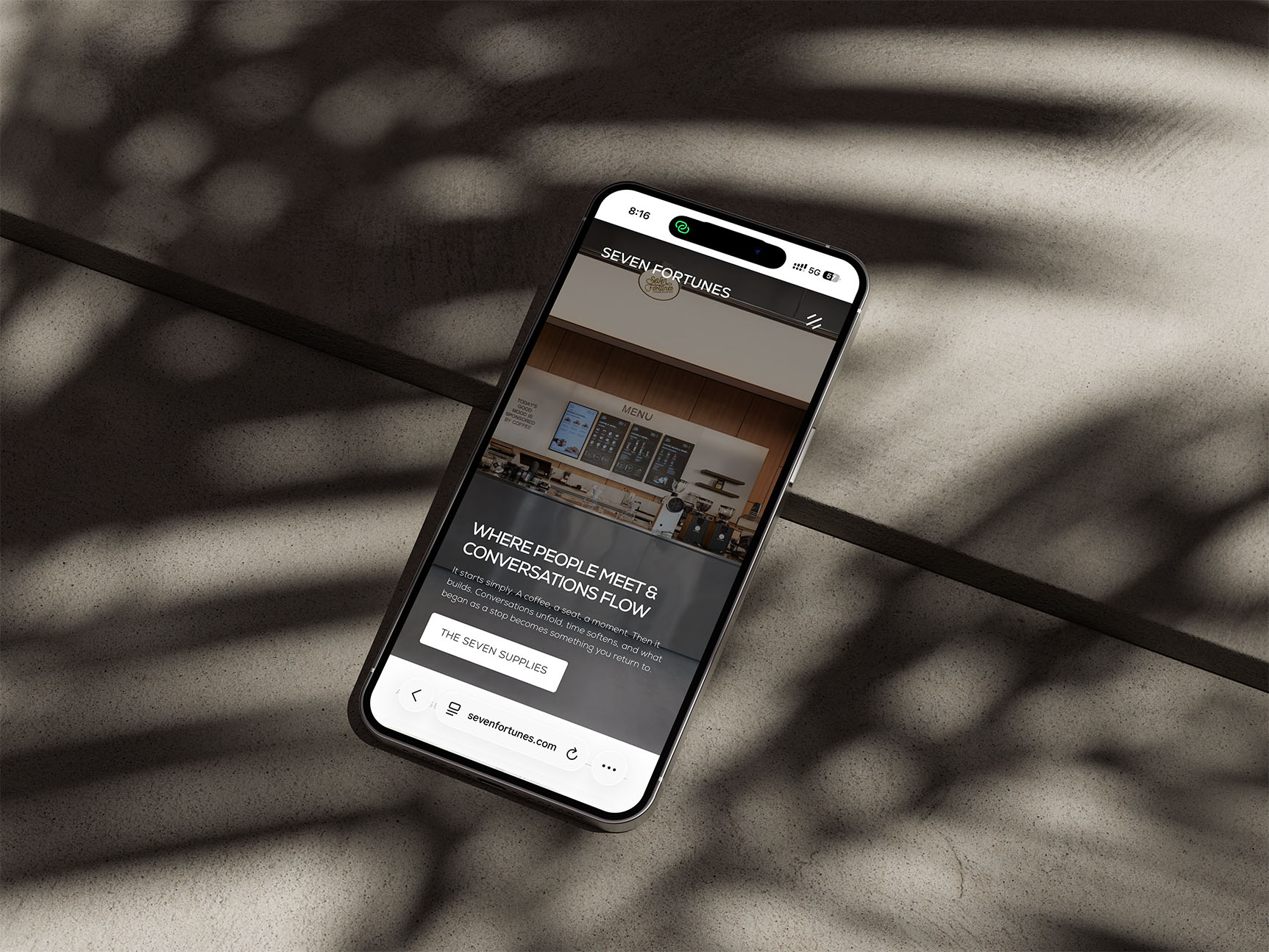
Brewing Seven Fortunes Online
A multi-market coffee platform connecting Egypt and the UAE through branch discovery, community galleries, and live bean ecommerce, with ordering and loyalty planned as future phases.
Case Study
A multi-market coffee platform connecting Egypt and the UAE through branch discovery, community galleries, and live bean ecommerce, with ordering and loyalty planned as future phases.
Seven Fortunes is one of Egypt’s best-known specialty coffee brands, with a physical presence and customer culture extending across Egypt and the United Arab Emirates. Translating that position into a digital experience required far more than a conventional coffee-shop website. The platform needed to communicate the character of the brand, help customers discover the right location in the right country, turn community participation into owned content, and create a serious ecommerce destination for the brand’s coffee beans. At the same time, it needed to become the first completed layer in a much broader plan for the modernization and digitalization of Seven Fortunes.
Client Context
Seven Fortunes operates in a category shaped by ritual, taste, identity, and repetition. Customers do not simply purchase a drink and leave. They build routines around particular branches, return to preferred coffees, photograph the spaces they spend time in, recommend the brand to others, and develop a relationship with the culture surrounding it. That relationship is especially important for a specialty coffee company whose value extends beyond the functional product into sourcing, preparation, atmosphere, and community.
The brand also operates across two countries. Egypt and the UAE share the same Seven Fortunes identity, but customers in each market need locally relevant branch information, content, and paths. A single flat website would have made that distinction difficult to manage and confusing to navigate. The platform therefore had to behave as a coordinated multi-market system while continuing to feel like one brand.
Monarq’s End-to-End Role
Monarq led the project from strategy through design and development. The work was not limited to producing screens or implementing a supplied layout. It included shaping the platform architecture, defining how the two markets should connect, planning the user journeys, designing the visual and interaction system, developing the website and commerce experience, and coordinating the content required to make the platform feel complete.
That end-to-end responsibility also extended into physical content production. Monarq collaborated with the Seven Fortunes marketing team to coordinate branch photoshoots, ensuring that the imagery required by the website reflected the spaces, atmosphere, and customer experience with enough consistency to work across the platform. This connection between content planning, product design, and development was essential. A coffee-shop platform can have a strong interface and still feel empty if the visual material does not support the intended journey.
The Strategic Challenge
The central challenge was to avoid reducing a major specialty coffee brand to a decorative information site. A basic solution could have listed branches, displayed a menu, and provided contact details. That would have answered immediate questions but failed to create lasting digital value. Seven Fortunes needed an experience capable of supporting discovery, commerce, participation, and future customer retention within one coherent foundation.
The project also had to balance several different behaviors. Some users arrive because they want the nearest branch. Others want to understand the brand, browse photography, or buy beans online. Customers in Egypt should not have to navigate UAE information before finding what is relevant, and customers in the UAE should feel that the experience speaks directly to their market. Each need had to remain easy to access without turning the website into a dense collection of disconnected tools.
A Multi-Market Digital Architecture
The country-switching system provides the structural foundation for serving Egypt and the UAE through a unified brand platform. Instead of treating the markets as unrelated websites or mixing every location into one undifferentiated directory, the experience allows users to enter the relevant national context and continue through content designed around it.
This structure improves clarity for customers and control for the business. New branches, local campaigns, market-specific information, and future services can be organized within the correct country experience while the brand maintains one consistent visual and technical system. It also gives Seven Fortunes a scalable model for additional markets should the company continue to expand.
Branch Discovery as a Core System
For a multi-location coffee-shop brand, branch discovery is one of the most important functional journeys. Customers often arrive with immediate practical questions: where the closest branch is, which location fits their plan, and how they can reach it. The branch finder was therefore designed as a core system rather than a secondary contact page.
By connecting country context, location information, and branch imagery, the platform turns a utilitarian search into part of the broader brand experience. Users can move from digital discovery toward a physical visit without losing orientation. For Seven Fortunes, this creates a clear bridge between its online presence and the network of spaces where the customer relationship is actually lived.
Photography and Branch Storytelling
Seven Fortunes’ branches are not interchangeable pins on a map. Each space contributes to the way customers understand the brand. The photoshoot coordination helped ensure the website could present those environments intentionally, supporting both practical location choice and emotional discovery.
Photography is integrated into the experience as evidence of atmosphere rather than used only as decoration. It gives potential visitors a sense of place, helps returning customers recognize familiar locations, and allows the brand’s physical investment to carry greater value online. The result is a richer branch experience that can evolve as locations are added or refreshed.
A Moderated Community Gallery
The gallery system transforms customers from passive visitors into participants. Users can submit photographs they have taken at Seven Fortunes, creating a direct route for the community to contribute to the brand’s digital story. This reflects an existing behavior: customers already photograph their coffee, meetings, routines, and time inside the branches. The platform gives that behavior a purposeful home owned by the brand.
Submissions pass through an approval workflow before publication. That moderation layer is important because it allows participation without giving up quality or brand control. Seven Fortunes can review what appears publicly, maintain a consistent standard, and build a growing library of authentic customer perspectives. The system creates engagement today while also establishing a behavioral foundation for the future loyalty experience.
From Participation to Loyalty
The gallery is significant because it begins to connect digital identity with real-world brand affinity. Loyalty should not be treated only as points added after a purchase. For a community-led coffee brand, it can also grow from recognition, contribution, repeat behavior, and a feeling of belonging.
The completed gallery does not claim to be the final loyalty system. Instead, it introduces a participation model that the future ecosystem can build upon. The broader loyalty concept remains part of the defined roadmap, with its blueprints prepared for a later phase. Presenting the distinction clearly protects the accuracy of the case study while showing that the current website was designed with a much longer customer journey in mind.
A Live Editorial Bean Store
The ecommerce component is live and allows Seven Fortunes to sell its coffee beans through the same digital environment used for brand and location discovery. This is not a generic catalog attached to a coffee-shop website. Monarq developed an editorial-commerce approach in which the character of each coffee shapes its individual presentation.
Rather than forcing every bean into an identical product template with only the name and photograph changed, individual product pages use unique design elements to communicate distinct identities. The experience gives each product space to express its own story and character while remaining part of a system that can scale as the range grows. This makes the store commercially functional without sacrificing the depth expected from a serious specialty coffee brand.
A First-of-Its-Kind Ecommerce Direction in Egypt
Within the Egyptian market, the bean store establishes a first-of-its-kind scalable editorial ecommerce direction for specialty coffee. Its significance is not based on visual variation alone. The achievement lies in combining individually art-directed product experiences with a repeatable commerce architecture capable of supporting operations and future catalog growth.
Editorial websites are often expressive but difficult to scale. Conventional ecommerce systems are scalable but frequently flatten every product into the same structure. The Seven Fortunes platform was designed to resolve that tension. It gives individual coffees a differentiated presentation while preserving the shared systems required for browsing, product management, purchasing, and expansion.
Product Storytelling and Coffee Discovery
Specialty coffee products carry more meaning than a standard inventory item. Origin, profile, preparation, and personal taste all influence the customer’s decision. The product experience therefore needed to support curiosity as well as conversion. Each page becomes an opportunity to help the coffee feel considered, distinctive, and worth exploring.
The editorial approach also strengthens the relationship between the physical coffee shops and the online store. A customer may discover a coffee through a branch visit and later purchase it online, or encounter it digitally before trying it in person. By presenting products with the same care given to the wider brand, the platform makes those journeys feel connected rather than divided between in-store coffee culture and online retail.
Experience and Visual Direction
The visual language is modern, minimal, and controlled, but it is not static. WebGL moments and interactive treatments introduce depth where they support attention and brand memory. Motion and immersion are used to strengthen the experience rather than compete with core tasks such as finding a branch or purchasing beans.
This restraint is especially important for a platform carrying several systems at once. The interface needed to accommodate brand content, country selection, location discovery, community imagery, and ecommerce without feeling crowded. Clear hierarchy allows each function to appear at the right stage of the journey, giving the site a premium sense of pace while preserving usability.
User Journeys
The platform supports several user intentions within one environment. A new visitor can understand the brand and explore its spaces. A nearby customer can select the correct country and find a branch. A community member can submit a photograph. A coffee enthusiast can enter the bean store, discover a product through an editorial page, and complete a purchase.
These journeys are not treated as separate microsites. They reinforce one another. Branch imagery strengthens brand perception, community submissions make the experience feel lived in, and ecommerce gives the relationship a transactional extension beyond the cafe. Together, they turn the website into a connected customer platform rather than a collection of pages.
Content and Operational Control
Behind the public experience, the platform gives Seven Fortunes a more structured way to manage a growing multi-country digital presence. Branch information, visual content, approved gallery submissions, and bean products can be maintained within a consistent architecture. This reduces the fragmentation that often develops when location pages, social content, and ecommerce are handled as unrelated channels.
The approval process for gallery submissions adds an important operational safeguard. The business can encourage community content while retaining editorial oversight. Similarly, the scalable product framework allows the bean range to expand without requiring the brand to abandon the individual creative treatment that makes the store distinctive.
Mobile Experience
Much of the audience will encounter Seven Fortunes from a mobile device while deciding where to go, browsing social content, or purchasing after a recommendation. The responsive experience therefore needed to preserve immediacy. Country selection, branch discovery, gallery participation, and shopping all have to remain clear on smaller screens.
Mobile was approached as a real usage environment, not simply a reduced desktop layout. Content order, interaction targets, imagery, and commerce steps were considered around practical customer behavior. The platform retains its editorial character while keeping important actions easy to locate and complete.
Performance and Scalability
Rich photography, WebGL interactions, user-generated media, and individually designed commerce pages can easily create a heavy or fragile experience if they are treated independently. The platform needed a technical foundation that could preserve its visual ambition while remaining maintainable as content, branches, products, and markets expand.
Scalability was therefore considered at both the system and design levels. Shared architecture supports repeatable operations, while flexible presentation rules prevent the experience from becoming generic. This balance is central to the project: Seven Fortunes can grow the platform without losing the crafted quality that distinguishes it.
The Modernization and Digitalization Roadmap
The completed website is the first major phase of a broader plan for Seven Fortunes. Monarq has developed blueprints and a defined roadmap for deeper digital modernization, including online ordering and loyalty. Those systems are not represented as live features in this case study; they remain planned phases with their strategic direction already established.
The online ordering vision is intended to extend the platform from discovery and packaged-bean commerce into a closer relationship with branch transactions. The loyalty vision is intended to connect repeat visits, purchases, participation, and customer engagement more meaningfully over time. Because the current platform already understands markets, branches, content, community contribution, and commerce, these future services can be introduced into an existing ecosystem rather than attached as isolated tools.
Why the Phased Approach Matters
Building the information, community, and commerce foundation first creates a more credible route toward ordering and loyalty. It gives the brand a stable public platform, establishes the content and location architecture, and begins shaping the user behaviors that future systems will serve. It also allows each phase to be implemented with clarity rather than attempting to launch a large collection of disconnected features at once.
This approach turns the roadmap into an evolution of one system. The website can deliver value in its current form while remaining structurally prepared for what follows. That is particularly important for a recognized brand operating across countries, where future services need to respect different markets and branch operations without weakening consistency.
Business Value
For Seven Fortunes, the project centralizes several important digital functions. It strengthens brand presentation, makes a multi-country branch network easier to navigate, creates an owned channel for customer participation, and opens a direct ecommerce path for coffee beans. It also provides a foundation through which future ordering and loyalty investments can become part of a unified customer experience.
The platform is therefore both a customer-facing destination and a long-term business asset. It can support branch expansion, market growth, product launches, community campaigns, and new digital services without requiring the brand to restart its digital presence for every initiative.
Outcome
The result is a completed multi-market website and live editorial bean store that represent the first phase of Seven Fortunes’ wider digital transformation. Customers across Egypt and the UAE can enter the right market experience, discover branches, engage with a moderated community gallery, and purchase coffee through product pages designed to give each bean an individual identity.
More importantly, the project establishes a coherent direction for what comes next. Online ordering and loyalty remain in the roadmap, supported by completed blueprints and by a platform intentionally designed to receive them. Seven Fortunes now has more than an information website: it has the public foundation of a connected digital infrastructure capable of growing alongside one of the region’s most recognizable specialty coffee brands.